Ask three tailors how to change a pair of trousers and you may hear three different answers. The reason is the silhouette: the width of a leg from thigh to ankle decides whether pants read as slim, tapered, straight or wide, and that width is what a tailor can and cannot move. A taper pants tailor works with the fabric already in the leg, so the real question is not whether a change is possible but how much room the garment has to give. At Stitch It, customers bring in pants with the wrong leg shape all the time. Here is what can be changed, what can’t, and how to decide before you pay for work you will regret.
Table of Contents
- Quick Takeaways
- What Each Silhouette Actually Means
- Can a Tailor Actually Change the Silhouette?
- How Taking In a Leg Creates a Slimmer Silhouette
- Going From Slim to Straight: Letting Out a Leg
- Side-by-Side Comparison of Common Alterations
- Where One-Sided Alterations Go Wrong
- What Silhouette Changes Cost at Stitch It
- Frequently Asked Questions
- References
Quick Takeaways
| Key Insight | Explanation |
|---|---|
| A silhouette is set by width from thigh to ankle | Length is only one measurement. The taper is the change in circumference as the leg moves down, and that is the measurement a tailor works with. |
| Hemming alone cannot turn a tapered leg straight | A hem removes the narrowest part of the leg, so the finished opening ends up wider than the original cut was designed for. |
| Taking in is the main tool for slimming | The tailor removes fabric from the inseam and outseam, and both seams should be changed by a similar amount. |
| Letting out depends on the seam allowance | A let out can only use fabric left inside the seam. If little remains, a straight or wide cut may not be reachable. |
| Changing only one seam can twist the leg | Removing all the excess from one side pulls the grainline and can make the leg spiral and the crease drift when you walk. |
| Fix the silhouette first, then the hem | Set the thigh, knee and ankle width before the length. The hem is the final step, not the first one. |
What Each Silhouette Actually Means
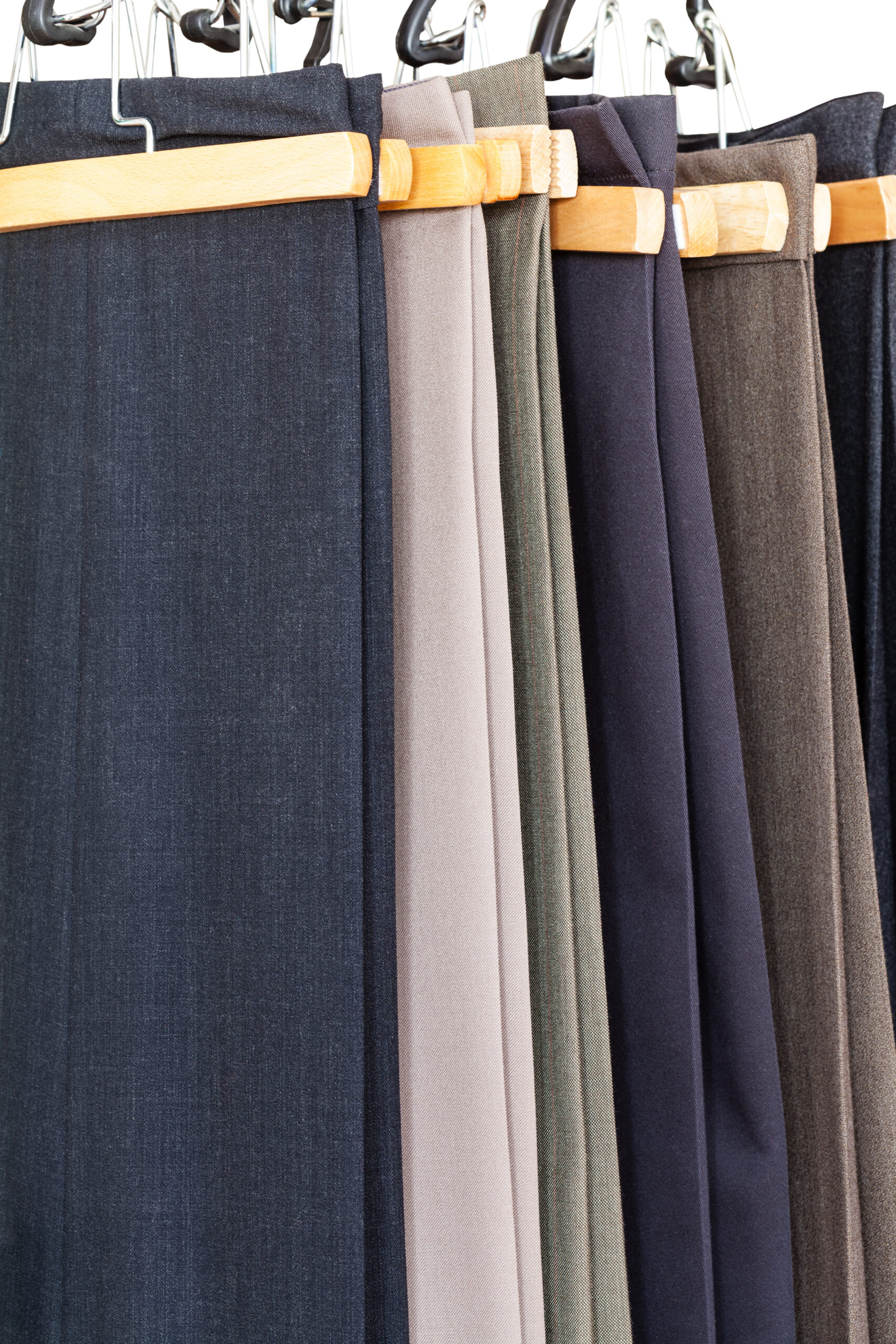
Pant labels are inconsistent, so start with the leg itself. Taper describes how the leg circumference changes from the thigh down to the ankle, and how closely the fabric falls against your leg. A slim or tapered cut is narrowest at the ankle and gets progressively wider moving up the leg. A straight cut sits in the middle, with much less change from top to bottom.
Boot cut pants have little taper at the ankle, leaving room for the shaft of a boot. Wide leg pants have almost no taper and may be as wide at the hem as anywhere else on the leg. These are the four shapes most people mean when they ask for slimmer or less baggy pants, and they are not interchangeable.
One menswear retailer’s fit guide describes a slim fit as staying close to the body from top to bottom, while a tapered fit offers more room in the thigh and narrows toward the ankle. That difference matters for alterations. A tapered fit has room in the thigh that a tailor can work with, while a slim fit is already close from top to bottom, so there is less fabric to remove.
A taper is a relationship between the thigh and the ankle, not a single measurement, so judge a pair by how the leg narrows from top to bottom.
Pro tip: Measure the leg opening at the ankle and the width at the knee of a pair you already like. Those two numbers tell you more about the silhouette than the label on the waistband.
Can a Tailor Actually Change the Silhouette?
Yes, but only within limits. A tailor can remove fabric from the inseam and outseam to narrow the leg, and in many cases can let seams out to add some width back. What a tailor cannot do is create fabric the garment never had, so the silhouette you can reach depends on how much material sits in the seams.
The bigger issue is that a hem and a silhouette are separate jobs. Many people bring in a pair that is too long and too wide at the ankle, and ask only for a hem. That works if the leg already has the shape you want. If it doesn’t, shortening the leg changes the opening without fixing the width.
Why Hemming Alone Cannot Switch a Silhouette
A reader of a tailoring blog put the problem plainly in a comment: “when you hem a pant leg that is tapered, you end up with a leg hole that is larger than ideal. Slim fit jeans end up looking like boot cut.” That is the core risk. Hemming removes the narrowest part of the leg, so the finished opening can be wider than the cut was designed for.
In practice, this means a hem is the last step, not the first. If the leg is too wide, the taper has to be addressed before the hem is set, or the finished pants will look like a different cut than the one you bought.
Reading the Leg Before You Commit
Before agreeing to any change, check three points: thigh room, knee shape and ankle opening. A pair with plenty of thigh room and a tight knee can often be tapered from the knee down. A pair that pulls across the thigh will not improve by narrowing the bottom, because the problem sits higher up.
Ask the tailor to show you the proposed line with pins on your own leg. A good alterations professional will walk you through where the fabric comes out and why, and will say plainly when a silhouette is out of reach.
Pro tip: Bring the shoes you plan to wear with the pants. Heel height changes how much break you see at the hem, so the length should be set in the footwear you will actually use.
How Taking In a Leg Creates a Slimmer Silhouette
Taking in is the main tool for slimming a leg. The tailor opens the side seams, measures how much fabric to remove, and sews a new seam that follows a smooth curve from the knee to the ankle. The change is usually made along both the inseam and the outseam, and the two seams need to be treated as a pair.
Where the Seam Comes In
Most taking in happens below the knee, where the leg has the most room to be narrowed without distorting the seat or thigh. The new line should start gradually above the knee and finish at the ankle. A sharp change at the knee is a common sign of a rushed alteration, and it shows up as a bulge or pinch when the pants are worn.
Each seam should come in an equal amount, or close to it. If one side comes in more than the other, the crease drifts and the leg hangs differently on each side. This is why a skilled tailor checks both legs on the wearer, since few bodies are perfectly symmetrical.
Keeping the Knee and Seat Intact
The knee is the hardest place to work, because it is where the leg bends and where the grainline shows most when you sit or walk. Taking in too far at the knee changes how the trousers move, not just how they look. For a simple taper, the seat and crotch should not be touched at all, and any change that reaches that area is a different job altogether.
For a deeper look at the mechanics, our guide on jeans alterations beyond the hem covers tapering and waist work in more detail, and tailoring pants for a sharper edge explains how the same principles apply to dress trousers.
Pro tip: Ask for the leg to be checked with the pants on and the shoes you plan to wear. A taper that looks right on a hanger can pull at the knee once you sit down.
Going From Slim to Straight: Letting Out a Leg
Going the other direction, from slim to straight, is a let out job, and it is far more limited. A tailor can only let out fabric that exists in the seam allowance, the extra material folded inside the seam. Once that allowance runs out, the leg cannot be widened without new fabric, and new fabric will not match the original.
Before buying a slim pair with the idea of loosening it later, check the inside of the leg. A narrow allowance means the straight cut you want may not be possible at all.
Letting Out a Tapered Leg
When there is enough allowance, the tailor opens the original seam and sews it again along a wider line, usually starting at the knee and blending into the thigh. The result is a straighter leg, though it will still carry some of the original shape, because the cut was built around the old seam.
A common mistake is expecting a let out to restore a boot cut or wide leg. Those shapes need more fabric at the ankle than most slim pants carry, so the change will look like a compromise rather than a true wide cut.
When the Fabric Runs Out
If the allowance is gone, the practical options are limited. You can accept a slightly narrower straight leg, adjust the hem, or buy a new pair in the cut you want. Trying to force extra width from elsewhere in the garment produces a pair that looks uneven and pulls in the wrong places.
Suit trousers and chinos face the same limits, although the hem choice can change the overall look. Our article on dress pants vs. chinos and whether they need different hems covers that distinction in more detail.
Side-by-Side Comparison of Common Alterations
Three changes come up most often with pants: taking in the leg, letting out the leg and hemming alone. Each one changes a different part of the silhouette, so compare them before you decide what to ask for.
| Approach | Best For | Main Limit |
|---|---|---|
| Taking in a straight or wide leg | Pants with extra width below the knee that should look slim or tapered | Needs enough room in the thigh and knee to keep the shape balanced |
| Letting out a slim leg | Slim pants that feel too tight through the leg and need a straight cut | Limited by the seam allowance left in the original garment |
| Hemming only | Pants where only the length is wrong and the leg shape already fits | Changes the leg opening and can make a tapered leg look wider at the hem |
Cost should come last in this decision. A taking in job that fixes the shape is worth more than a cheap hem that leaves the leg wrong, because the hem cannot correct a silhouette problem higher up the leg.
The right choice is usually the simplest change that solves the real problem. If the thigh fits and the leg is only too wide below the knee, taking in is the answer. If the leg is pulling across the thigh, no amount of hemming or narrowing at the ankle will solve it.
Where One-Sided Alterations Go Wrong
The most common failure is changing only one seam. If all the excess is removed from the inseam, the grainline pulls toward the inside of the leg, and the fabric can twist as the wearer walks. Removing it all from the outseam produces the same problem in reverse.
An experienced member of a sewing forum described this in a thread about tapering men’s slacks. Taking everything out of the inseam pulls the grainlines, and when the wearer walks the pants can want to spiral around the legs, with creases heading toward the inner ankle. Much of that advice was aimed at home sewists, but the principle applies to any tailor: the alteration has to be balanced across the leg.
Balancing the Inseam and Outseam
Balancing means splitting the change between both seams so the crease stays centered. In practice, the tailor pins the leg on the wearer, checks the crease from several angles, and then makes the same adjustment on each side. It takes longer, and it is what separates a clean taper from one that looks slightly off from across the room.
Why Both Legs Need Checking
Few bodies are perfectly symmetrical. A pair that looks even on a hanger may sit differently on each leg once it is worn, so both legs should be fitted to the wearer rather than copied from one side. A common mistake at home is marking one leg, putting the pants on inside out and losing track of which leg is which.
This is also why we ask customers to book a fitting check before any cutting. Once the seam is sewn and trimmed, the options for correction are narrow.
Pro tip: Walk, sit and cross your legs in front of a mirror after the fitting. Problems with grainline and spiral show up in motion before they show up while standing still.
What Silhouette Changes Cost at Stitch It
Pricing for silhouette work depends on the garment and how much change is needed, but our published starting prices give a clear baseline. Hems start at $14.89, and pant hems also start at $14.89. Take in or let out work starts from $23.84, which is the service that most directly changes the silhouette of a leg.
Walk-Ins, Rush Work and the 30-Day Fit Guarantee
Walk-ins are welcome and no appointment is needed, which helps when you need a pair fixed before an event. Rush service is also available. Every alteration is backed by our 30-Day Fit Guarantee, which means love it or we fix it.
Bringing the Right Pants to a Fitting
Bring the pants you want changed, the shoes you plan to wear and, if you have one, a pair that already fits the way you want. The reference pair shows the tailor the target silhouette, which is far easier to match than a verbal description like “less baggy.”
Repairs and small fixes are priced separately. Repairs and patches start from $8.23, and buttons and zippers start from $3.12, so a silhouette change can be combined with other work in one visit.
Frequently Asked Questions
Can a tailor make tapered pants straight?
Sometimes, but only by letting out the leg within the seam allowance that remains. If the allowance is small or gone, the leg cannot be widened to a true straight cut, and changing the hem will not fix that.
Can straight-leg pants be tapered?
In most cases, yes. Taking in works best when the thigh and seat have enough room and the leg is wider below the knee. If the thigh is already snug, the taper has to be balanced carefully, and some pairs are better left straight.
Will hemming change the taper of my pants?
It will. Hemming removes the narrowest part of a tapered leg, so the finished opening can end up wider than the original design. Check the silhouette first, then set the hem.
How much does it cost to taper pants at Stitch It?
Take in or let out work starts from $23.84, and the final price depends on the garment and how much change is needed. If only the length needs fixing, hems start at $14.89.
Should I bring a reference pair to the fitting?
Yes. Bring a pair that already fits the way you want, along with the pants to be altered and the shoes you plan to wear. The reference helps the tailor see the target silhouette.
What happens if the fit is still wrong after the work?
Stitch It offers a 30-Day Fit Guarantee, which means love it or we fix it. Ask about the guarantee when you drop off your pants so you know what is covered before the work starts.
Have you had a pair of pants tapered or let out, and did the result match what you pictured? Share your experience below so other readers can learn from it.
References
- Tailoring blog post on tapering, slim and straight cuts, and how hemming changes the leg opening
- Sewing forum discussion on tapering men’s slacks and grainline problems
- Guide to choosing men’s pants by fit type and body shape