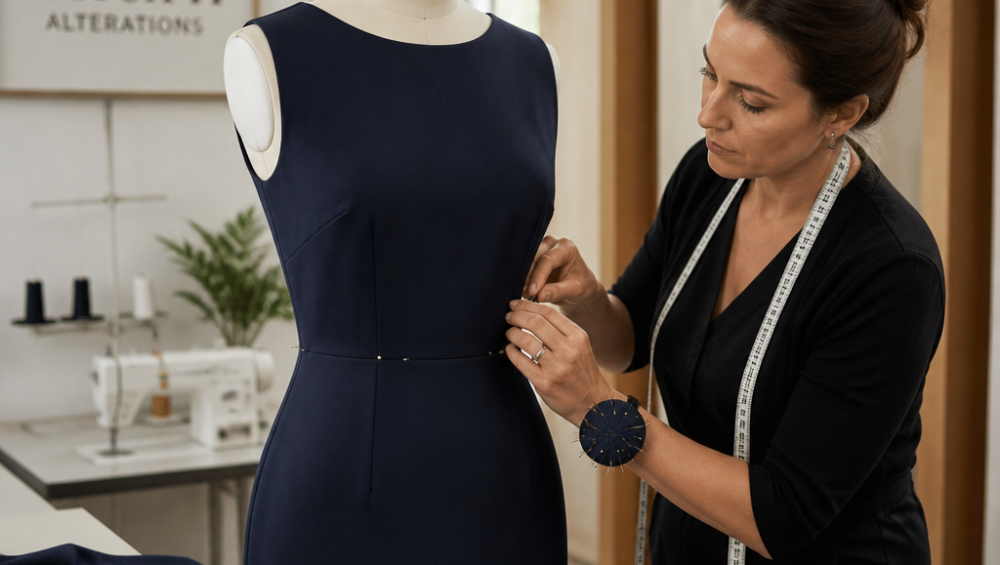
Most dresses are designed to fit a single, standardized measurement chart. Your body almost certainly doesn’t match that chart exactly, and that’s not a problem with you. It’s a problem with ready-to-wear sizing. Dress alterations exist to close this gap, translating a “close enough” fit into something that actually looks intentional. Whether you’re preparing for a wedding, updating your everyday wardrobe, or finally getting a formal gown to sit right across the shoulders, the right alterations transform a garment from frustrating to flattering. This guide breaks down the specific alterations that work for each body type, so you stop guessing and start getting dressed with confidence.
Table of Contents
- Why Off-the-Rack Rarely Fits
- Quick Takeaways
- Understanding Your Body Type Before Alterations
- Dress Alterations for Pear-Shaped Bodies
- Dress Alterations for Apple-Shaped Bodies
- Dress Alterations for Hourglass Bodies
- Dress Alterations for Petite Bodies
- Dress Alterations for Plus-Size Bodies
- Dress Alterations for Inverted Triangle Bodies
- Comparing Common Alteration Approaches
- What to Bring to Your Fitting Appointment
- Frequently Asked Questions
- References
Why Off-the-Rack Rarely Fits
Clothing manufacturers use a single set of standardized measurements when grading their size ranges. The result is a dress that might fit your bust but gaps at the waist, or fits your hips but swims at the shoulders. This is not a niche problem. It affects the majority of shoppers across every size range.
The practical solution isn’t to keep shopping for a better fit. It’s to buy for your largest measurement and alter everything else. This approach consistently produces better results than trying to find a garment that fits perfectly without any professional adjustment. A skilled tailor or seamstress works with the seam allowances, darts, and construction of a specific garment to reshape it around your actual proportions.
Garment construction is the factor most people overlook before buying. Dresses with vertical seams, side seams, and darts offer far more alteration potential than bias-cut or knit styles. Understanding this upfront saves both frustration and money, especially when you’re investing in a formal or bridal piece.
Quick Takeaways
| Key Insight | Explanation |
|---|---|
| Buy for your largest measurement | Always size up to accommodate your widest point, then have the rest tailored down. Taking in is easier and cleaner than letting out. |
| Seams and darts determine alteration potential | Dresses with structured seams, vertical panels, and darts can be meaningfully reshaped. Bias-cut and seamless knit styles have very limited adjustment range. |
| Bring the right undergarments and shoes to every fitting | Your heel height changes the hemline, and your undergarments change how the bodice sits. Both must be present at the fitting or the alteration measurements will be off. |
| Waist suppression is the single highest-impact alteration | Adding or deepening darts at the waist creates shape on nearly any body type, transforming a boxy silhouette into one with intentional structure. |
| Hemming is body-type-specific, not just length-based | For petite frames, shortening at the waist rather than the hem preserves the intended proportions of the dress. For tall frames, lengthening with a modesty panel may be needed. |
| Letting out has hard limits | Most ready-to-wear dresses have limited seam allowances. Letting out more than one to two inches risks exposing raw edges or distorting the design. Plan around this when buying. |
| Same-day alterations exist for genuine emergencies | Simple fixes like a broken zipper, a snapped strap, or a basic hem can often be completed same day at a full-service alterations shop. Rush work on structured garments typically requires at least a day’s notice. |
Getting alterations right comes down to knowing what each body type actually needs. The sections below address each shape with the specific adjustments that make the most difference, not general styling advice.
Understanding Your Body Type Before Alterations
Body type is a useful starting point for alterations, but it’s not the whole picture. Your torso length, shoulder slope, high hip versus low hip measurements, and bust cup size all influence which specific adjustments a dress needs. A petite pear and a tall pear will need different hemline treatments even if their hip-to-shoulder ratio is identical.
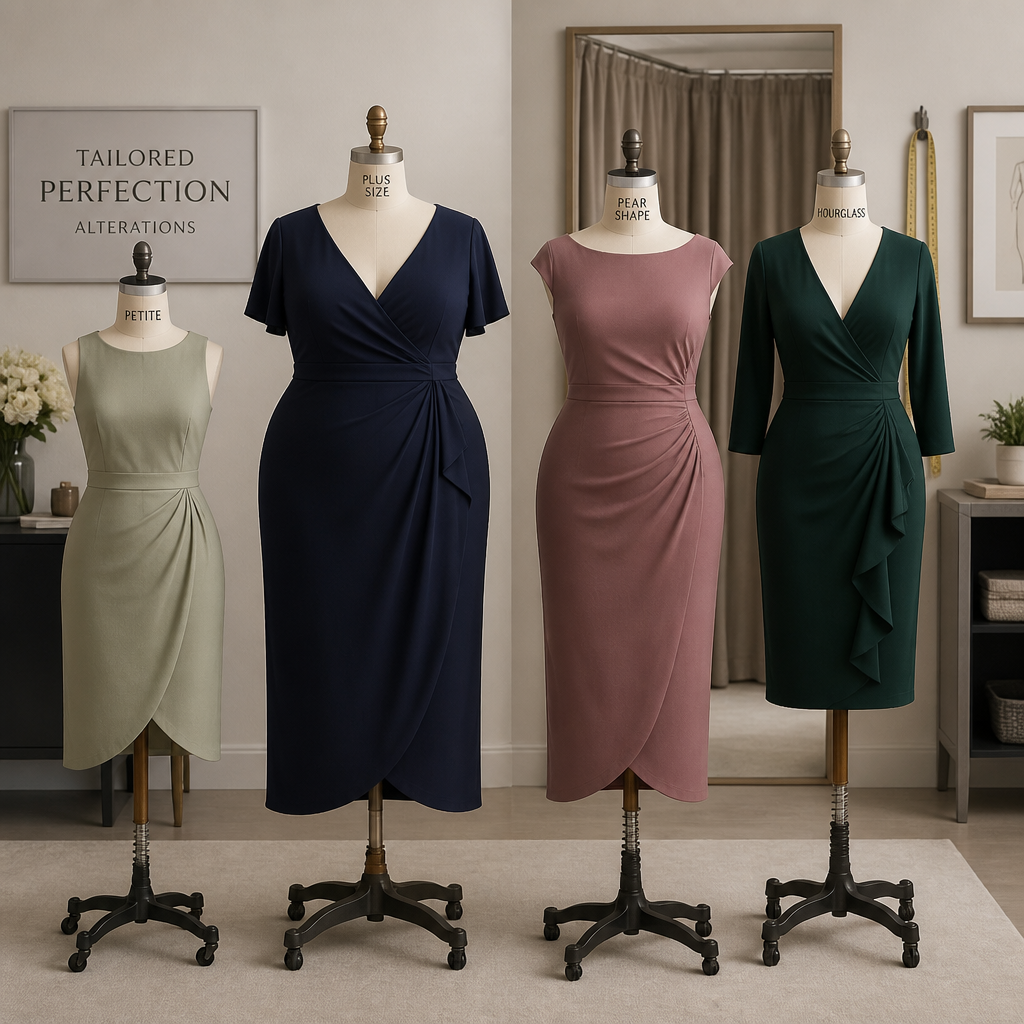
The five most commonly referenced shapes for dress fitting purposes are: pear (narrower shoulders, fuller hips), apple (fuller midsection, narrower lower body), hourglass (balanced bust and hips with a defined waist), inverted triangle (broader shoulders, narrower hips), and rectangle (similar measurements throughout with less waist definition). Petite and plus-size considerations cut across all of these shapes and add their own layer of fitting needs.
When you walk into a fitting appointment, be specific about what bothers you rather than just asking for “a better fit.” Naming the exact problem, whether it’s gaping at the back, pulling across the hips, or straps that fall off the shoulders, allows a professional tailor to go straight to the solution.
Dress Alterations for Pear-Shaped Bodies
Pear-shaped bodies carry more volume through the hips and thighs than through the bust and shoulders. The core fitting challenge is that most dresses are graded proportionally, meaning a dress sized to fit the hips will be too loose through the bodice, and a dress sized to fit the bust will be too tight below the waist.
Buy for the hips, alter the top
The correct approach is to buy the size that accommodates your hips, then bring in the bodice, take in the side seams above the waist, and adjust the straps or neckline as needed. This approach produces a clean, tailored line through the top half without any stress across the hip seams.
A-line and empire-waist silhouettes naturally work well for pear proportions because they draw attention upward and skim rather than cling below the waist. When you find one of these styles in the right fabric, alterations are typically minimal: a bodice take-in, strap adjustment, and hem. That’s a fast, cost-effective appointment.
Hemming for hip-forward proportions
Because the skirt section of a dress must accommodate fuller hips, the hemline sometimes drops slightly lower at the sides than at the front and back. A tailor can level the hem after the fit across the hips is confirmed. Always get the hip fit right before addressing the hem, not the other way around.
Pro tip: If a dress zips smoothly over your hips but has visible extra fabric pooling at the sides of your waist, that’s a side-seam take-in. Ask the tailor to take in both side seams from just below the bust to just above the hip. The transformation takes under an hour and costs far less than replacing the dress.
Dress Alterations for Apple-Shaped Bodies
Apple-shaped bodies carry more weight through the midsection than through the hips and legs. The fitting challenge here is creating shape and elongation through the torso without adding bulk. The right alterations make the legs and bust the visual focal points rather than the midsection.
Waist-defining alterations on apple shapes
Empire-waist dresses with seaming just below the bust are among the most alteration-friendly options for apple shapes. A skilled tailor can take in the empire seam slightly to create the suggestion of a waist, then let the skirt fall freely over the midsection without clinging. This creates visual definition without constriction.
Ruching and wrap-style dresses are also effective, but they need to be correctly placed. Ruching that sits directly over the widest part of the midsection adds volume. A tailor can sometimes reposition or reduce ruching so it falls at the side seam rather than the front panel.
Neckline and strap adjustments
Apple-shaped individuals often have a broader chest and fuller bust, which means straps need to be shortened to lift the neckline and prevent the bodice from pulling forward. Deep V-necks and scoop necklines are flattering for this shape, and adjusting strap length is one of the simplest and most affordable alterations available.
The best alteration is the one that makes a garment look as though it was made for you, not the one that makes the alteration visible. Every seam decision should serve the fit, not the shortcut.
Dress Alterations for Hourglass Bodies
Hourglass proportions, balanced bust and hips with a significantly smaller waist, are rarely matched by off-the-rack sizing because manufacturers reduce the waist measurement by a fixed ratio as sizes scale. The result is a dress that fits the bust and hips but has too much fabric at the waist, or one that fits the waist and pulls uncomfortably across the bust and hips.
Waist suppression is the primary adjustment
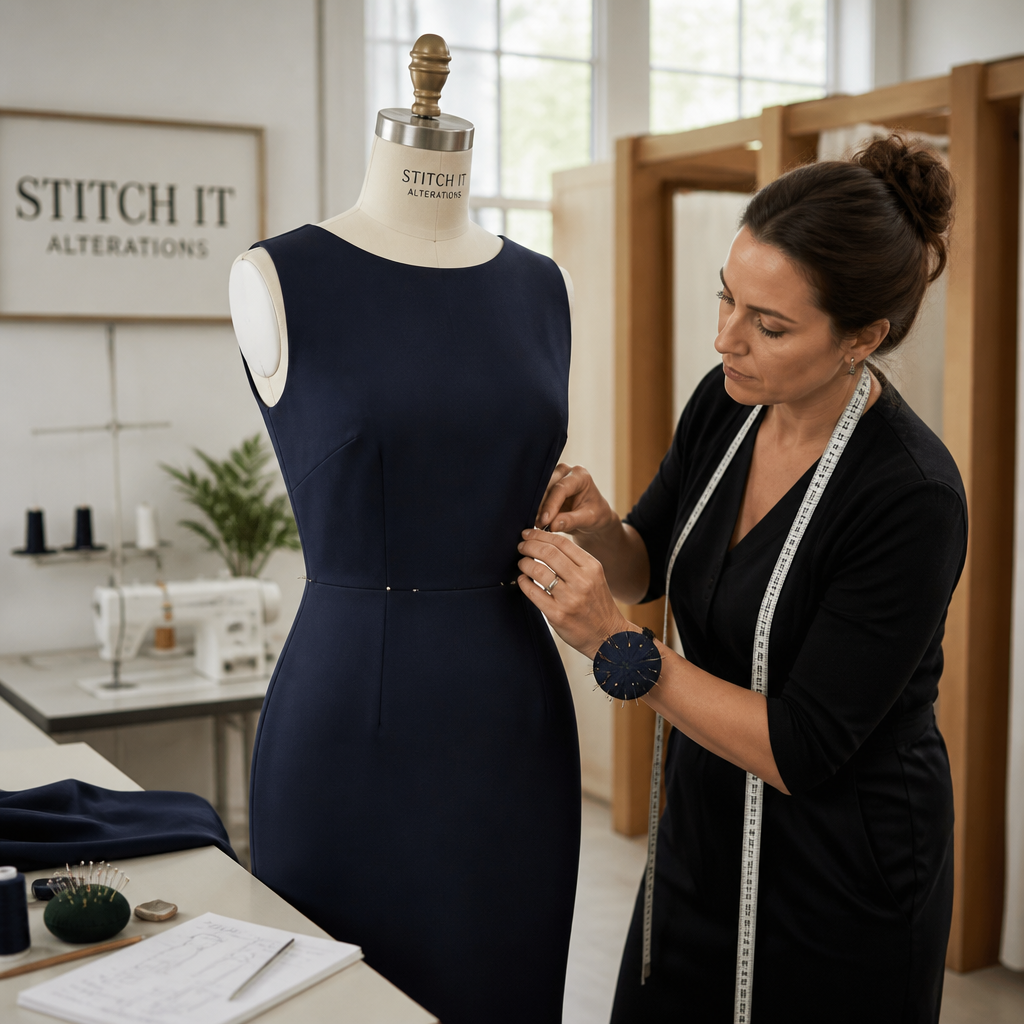
The most effective alteration for hourglass bodies is waist suppression through dart adjustment or side-seam tapering. A tailor takes in the waist seams to match the actual waist measurement while leaving the bust and hip sections intact. On a dress with back seams, this can be done cleanly from the back without touching the front panels at all.
Fitted wrap dresses and sheath styles work beautifully once waist-suppressed, because these silhouettes are designed to follow the body’s natural curves. If you find one in a fabric with some stretch, the alteration potential increases significantly.
Pro tip: When trying on a fitted dress, pay attention to where the zipper pulls. If it goes up easily over the hips but resists at the bust, the waist is not the only issue: the bust may need to be let out slightly while the hips are taken in. Tell your tailor exactly where the resistance is so they can address both points in one appointment.
Dress Alterations for Petite Bodies
Petite bodies, generally under five feet four inches in height, face a specific set of proportional challenges that go beyond simple hemming. Ready-to-wear garments are drafted for a taller frame, which means waistlines sit too low, bust darts are positioned too low, and skirt sections are too long relative to the torso.
Shorten at the waist, not just the hem
The most common mistake petite wearers make is hemming a dress at the bottom while leaving the waist and dart positioning untouched. This approach shortens the garment without addressing the proportional mismatch. The waistline of the dress ends up sitting on the hip rather than at the natural waist, which shortens the appearance of the legs rather than elongating it.
The correct alteration is to remove fabric from the waist seam or from within the bodice, repositioning the waistline higher before addressing the hem. This is a more involved alteration, but it produces a result that looks custom-made rather than just cut short.
Strap and shoulder adjustments for petite frames
Shoulder seams frequently sit too far down the arm on petite frames, which alters the hang of the entire bodice. Bringing the shoulder seam inward is a more complex alteration but has an outsized effect on how the dress sits. For spaghetti strap styles, shortening the straps is simpler and highly effective.
Petite proportions also benefit from a shorter hem length, typically just below or at the knee rather than midi or maxi length, to maintain the visual leg line. If you love a maxi style, hemming combined with waist repositioning gives you the look without the proportional compromise.
Dress Alterations for Plus-Size Bodies
Plus-size bodies face both proportional and construction challenges with off-the-rack dresses. Many manufacturers extend sizing without adjusting the placement of darts, seams, or waistlines, meaning a size 18 dress may simply be a scaled-up version of a size 10 pattern without any adjustment for the different shape that comes with a fuller figure.
Dart and seam repositioning
Bust darts are frequently the first alteration needed. When a dress is scaled up without repositioning the dart, the dart apex (the pointed tip of the dart) sits too low relative to the actual bust, which causes the fabric to pull downward and the bodice to look ill-fitting. A tailor repositions the dart apex to match the wearer’s actual bust point, which immediately improves how the entire bodice sits.
Side seam adjustments at the hip and thigh are also common. Because plus-size bodies carry volume differently depending on the individual, a tailor works with the actual measurements rather than assumptions based on size tags. This is where a professional fitting appointment, rather than at-home alterations, makes a real difference in the outcome.
Back adjustments and closures
Zipper stress and gaping back necklines are two of the most frequent complaints from plus-size clients. A tailor can replace a back zipper with a longer or different-gauge zipper, or add a hook-and-eye extension above the existing closure to relieve stress without altering the dress silhouette. For back necklines that gap, a small take-in across the upper back is a quick fix that improves overall structure significantly.
Dress Alterations for Inverted Triangle Bodies
Inverted triangle bodies have broader shoulders and a fuller bust relative to the hips, often with a narrower waist and slim lower body. The goal of alterations for this shape is to create visual balance by adding interest or volume below the waist and softening the shoulder line.
Alterations can involve adding structured skirt volume, such as a lining layer or petticoat insert, to create a fuller lower half. For dresses with shoulder seams, bringing the seam line inward can visually soften broad shoulders. A deep V-neck or square neckline, when it’s part of the original design, naturally draws the eye inward and downward, reducing the perceived width of the shoulders.
For inverted triangle shapes, the waist area typically fits well or runs slightly large, which means waist suppression through simple dart addition is often the most effective single alteration. Creating a defined waist visually narrows the shoulder line by comparison.
Comparing Common Alteration Approaches
Not all alterations are created equal in terms of complexity, cost, or impact. Understanding the difference between these approaches helps you prioritize what to request and what to expect from a fitting appointment.
| Alteration Type | Best For | Complexity and Considerations |
|---|---|---|
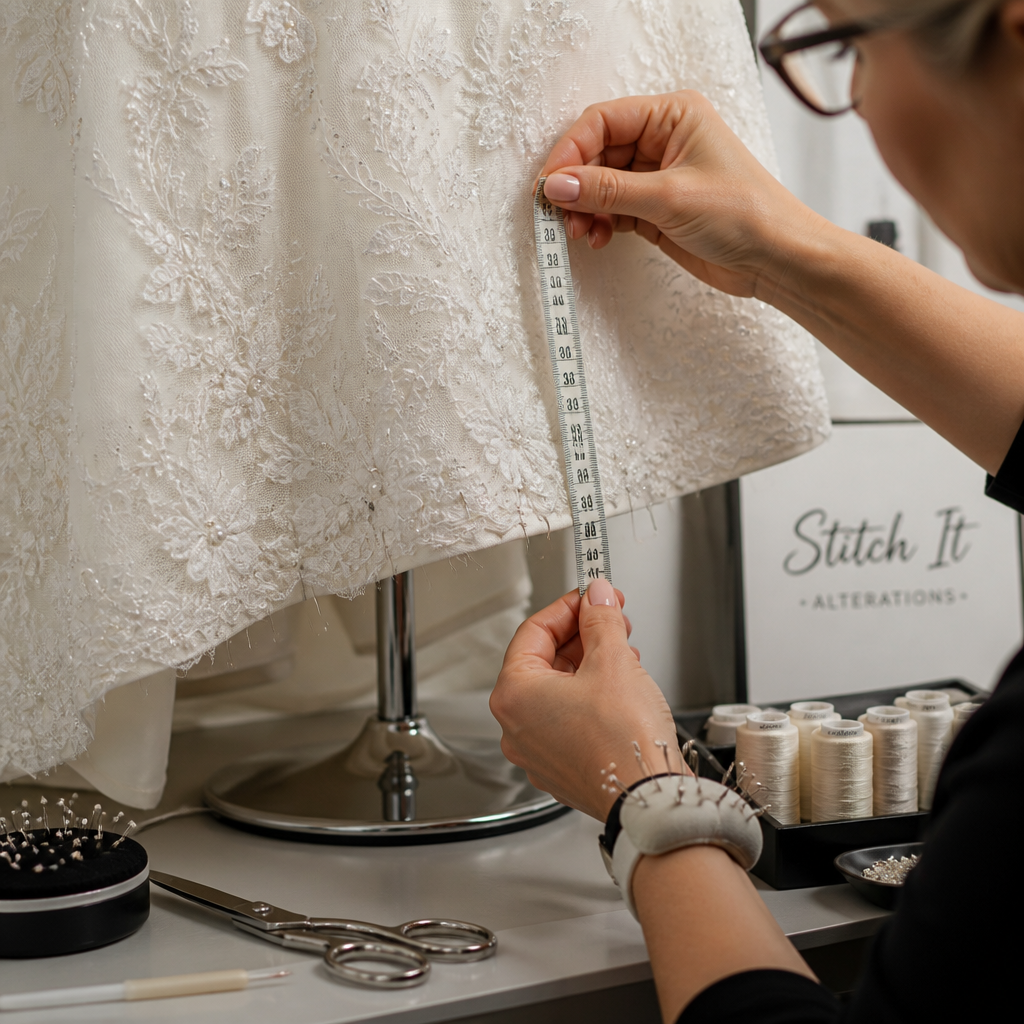
| Hemming | All body types needing length adjustment. Petite frames benefit most from waist-level shortening rather than hem-only shortening. | Low to moderate complexity. Simple hems are quick. Beaded, lined, or horsehair-banded hems require more time and skill. |
| Taking In Side Seams | Pear shapes taking in the bodice, hourglass bodies needing waist suppression, rectangle shapes adding definition. | Moderate complexity. Requires re-pressing and may affect zipper placement. Most effective when done symmetrically on both sides. |
| Dart Adjustment or Addition | Apple, plus-size, and rectangle bodies where the bodice lacks shape. Also used to reposition bust darts when the garment is scaled without proportional adjustment. | Moderate to high complexity. Dart repositioning on structured fabrics requires an experienced hand to avoid puckering. Highest impact-to-effort ratio of any alteration. |
What to Bring to Your Fitting Appointment
A fitting appointment only works as well as the information you bring into it. Showing up with the wrong shoes or no undergarments produces measurements that don’t reflect how the dress will actually sit on your body when you wear it, which means the alterations will be off.
Bring the exact shoes you plan to wear. Heel height directly determines hemline. A difference of even two inches between shoe heights can shift a hemline by two to three inches depending on the dress silhouette. If you’re not sure which shoes you’ll wear, bring both options and have the tailor pin the hem at the length that works for the taller shoe. You can always wear a lower heel and take up a bit of length with hemming tape temporarily.
Bring the undergarments you plan to wear with the dress, whether that’s a strapless bra, a corset-style bodysuit, or shapewear. These undergarments change how the bodice sits, where the dart needs to land, and how the dress falls across the hip. Without them, the fitting is incomplete.
If you’re bringing in a bridal gown or formal dress for a significant event, schedule at least two fittings: one for initial pinning and one for a final review after the alterations are made. The final fitting should confirm that everything is flawless before the event date, not the day before.
Stitch It’s bridal alterations appointments are designed with exactly this process in mind, and the team works through both the structural and finishing details that make a gown feel truly personal. For formalwear and everyday alterations, walk-ins are welcome with same-day and rush services available for straightforward fixes.
Pro tip: Take a photo of how the dress fits before the first pinning appointment and ask the tailor to confirm in writing which adjustments were marked. This creates a clear record if any adjustment gets missed between the first fitting and the final pickup, and it gives you a baseline for comparison at the review fitting.
Frequently Asked Questions
How much do dress alterations typically cost?
The cost depends on the type of alteration, the complexity of the garment’s construction, and how many adjustments are needed. Simple hemming and strap adjustments sit at the lower end of the price range. Structured bodice work, dart repositioning, and full waist suppression cost more because they are labor-intensive and require an experienced tailor. Bridal and formalwear alterations are generally priced higher than everyday garment alterations due to the fabric complexity and finishing standards required. Stitch It lists its starting prices clearly on the website so you know what to expect before walking in.
Can any dress be altered to fit any body type?
Not every dress is equally alterable, and this is important to know before buying. Dresses with vertical seams, side seams, and darts offer the most adjustment potential. Bias-cut and seamless knit styles have very limited range. In general, taking in is always easier than letting out, and letting out is often limited by how much seam allowance exists in the original garment. A good tailor will tell you upfront what is and isn’t achievable with a specific piece.
How many fittings do I need for a wedding dress?
Most bridal alterations require two to three fittings. The first appointment establishes initial measurements and marks the adjustments. The second fitting checks the work and makes any fine adjustments. A third fitting is a final review, particularly for complex gowns with multiple alteration points. Rushing this process to fewer appointments increases the risk of a fit issue going unnoticed until the wedding day.
What is the difference between taking in and letting out a dress?
Taking in means removing excess fabric by sewing the seam line inward, making the garment smaller. Letting out means opening an existing seam to release fabric, making the garment larger. Taking in is generally easier and cleaner because you have fabric to work with. Letting out depends entirely on how much seam allowance was left in the original construction. Most ready-to-wear garments have limited seam allowances, often restricting letting out to one to two inches maximum without compromising the structural integrity of the garment.
Should I get alterations done on everyday clothing or just formalwear?
Everyday clothing is absolutely worth altering, particularly pieces you wear regularly. A pair of trousers or a work dress that fits well across the shoulders but pulls at the waist will never feel comfortable no matter how many times you wear it. The cost of a simple alteration on an everyday piece is almost always less than the cost of replacing it, and a well-fitted everyday garment looks noticeably more polished than an ill-fitting one. Stitch It’s everyday alterations service covers exactly this kind of practical wardrobe improvement.
How long does it take to get a dress altered?
Timelines vary by the complexity of the work and the shop’s current capacity. Simple alterations like strap shortening or a basic hem can often be completed same day at a full-service alterations shop. More involved work, including structured bodice alterations or multi-point bridal fittings, typically takes several days to a week or more per round of fittings. Rush and same-day services are available at Stitch It for walk-in clients with straightforward alteration needs.
What alteration made the biggest difference in how your clothing fits? Share your experience in the comments, we read every one.
References
- Guide to dress alterations tailored to different body shapes and proportions
- Practical clothing alterations guide covering garment construction and what can realistically be changed
- What to bring to a formal dress fitting and how evening gown alterations work
- Overview of dress alteration costs and factors that affect final pricing